Wondering how to make your Los Altos yard feel more like part of your home, without creating a project that is hard to maintain or awkward to sell later? You are not alone. Many homeowners want an outdoor space that feels comfortable, flexible, and polished, while still fitting Los Altos’ preference for mature landscaping, water-wise design, and neighborhood character. The good news is that the best outdoor living rooms usually follow the same formula: useful space first, smart upgrades second, and local rules from the start. Let’s dive in.
Why outdoor living works in Los Altos
In Los Altos, outdoor upgrades tend to work best when they expand how you live at home without turning the yard into a sea of pavement. The city’s single-family design guidance emphasizes preserving neighborhood character, mature trees, and a semi-rural feel. It also encourages drought-tolerant planting and water-conserving irrigation.
That matters because a successful yard transformation here is not just about adding features. It is about creating usable gathering space while keeping the landscape balanced, shaded, and visually soft. In practice, that often means combining seating, planting, and lighting in a way that feels integrated rather than oversized.
There is also a resale angle. National REALTOR research shows that curb appeal matters to both agents and buyers, with strong agreement that it helps attract attention before and during a sale. For Los Altos homeowners, that suggests your yard can support both everyday enjoyment and marketability when improvements are thoughtful and well executed.
Start with usable outdoor floor space
If you want your yard to function like an outdoor living room, begin with the foundation: a comfortable place to sit, gather, and move around. A patio or deck often does the most work because it creates a clear zone for furniture, conversation, dining, or quiet evenings outside.
National remodeling benchmarks support that logic. In the 2023 outdoor features report, a new patio recouped 95% of cost and a new wood deck recouped 89% on average. These are national benchmarks rather than Los Altos-specific valuations, but they are still useful for planning priorities.
In many Los Altos yards, this means adding enough hard surface to make the space functional, while avoiding too much paving. That approach lines up with local guidance that warns excessive pavement can reduce landscape area and detract from neighborhood character. A well-sized patio surrounded by planting often feels more natural than trying to pave every open area.
How to size the space well
A good outdoor living room does not need to be huge. It needs to feel intentional. You want enough room for furniture placement, clear walking paths, and a layout that does not crowd nearby planting or tree roots.
As you plan, think about how you actually use the yard. A smaller, well-placed seating area close to the house may get more daily use than a larger project pushed to the far back corner. If resale is part of your thinking, flexible layouts usually appeal to a wider range of future buyers than highly specialized zones.
Add comfort with shade and lighting
Once the floor space is in place, the next upgrades usually bring the biggest lifestyle jump: shade and lighting. These are the features that make the yard usable beyond a perfect sunny afternoon.
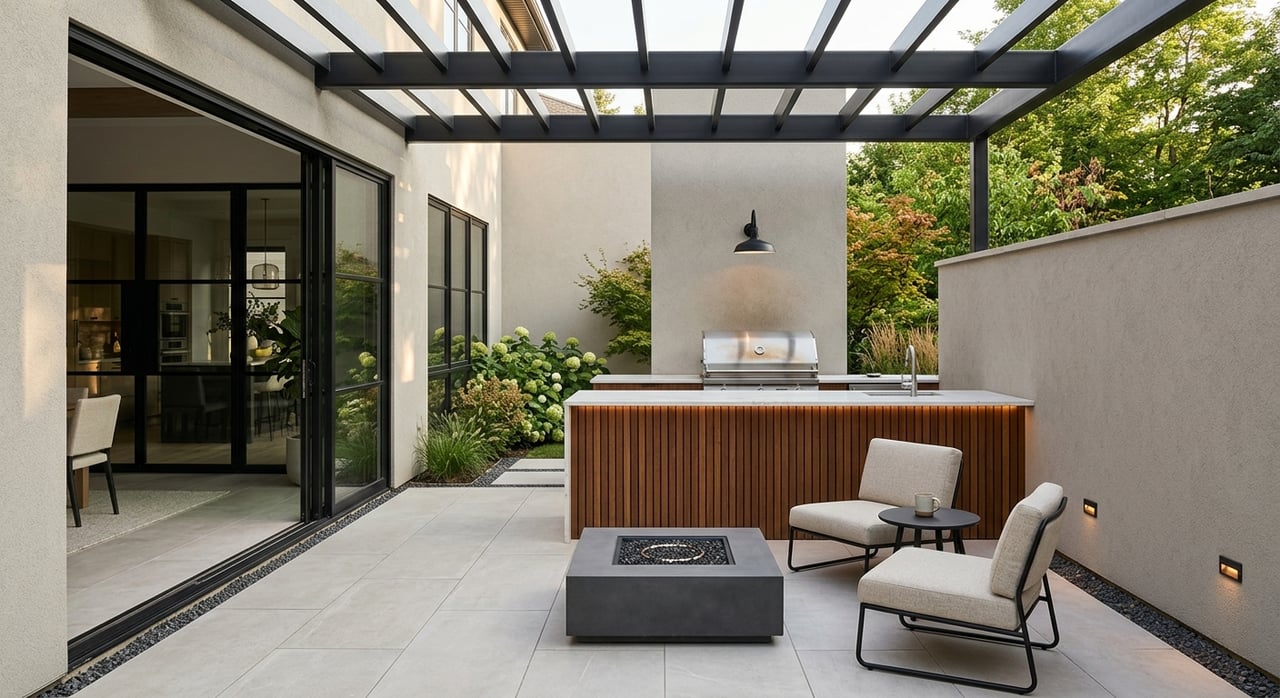
Shade can come from existing mature trees, preserved landscape features, or structures like pergolas and trellises. In Los Altos, that can be a smart way to create comfort while respecting the area’s preference for established greenery and a softer streetscape.
Lighting helps extend the space into the evening, but it should be subtle. The city exempts low-intensity landscape lighting that is directed downward and under 150 lumens per fixture. For larger residential projects, lighting plans may need to show fully shielded fixtures, a color temperature of 3,000 Kelvin or less, no light trespass, and no fixtures within 5 feet of the property line.
Keep lighting calm and functional
For most homeowners, the goal is not dramatic brightness. It is safe movement, soft ambiance, and visual definition. Path lights, gentle uplighting used carefully, and subtle illumination near seating areas can make the yard feel inviting without overwhelming the landscape.
This also fits the broader Los Altos design context. Outdoor spaces tend to feel more refined when lighting supports the yard rather than competes with it. In other words, you want evening usability, not glare.
Choose landscaping that lowers upkeep
A true outdoor living room should make life easier, not create a long weekly to-do list. In Los Altos, low-maintenance landscaping often means reducing unused turf, improving irrigation efficiency, and choosing drought-tolerant plants.
The city recommends repairing irrigation leaks, converting zones to drip irrigation, using smart controllers or rain sensors, spreading mulch, and replacing unused lawn with drought-tolerant plants, ideally California natives. According to the city, turf replacement can reduce outdoor water use by 15% to 50%.
That kind of planning helps in two ways. First, it can lower maintenance and water demand. Second, it supports the look many buyers appreciate in Los Altos: a yard that feels established, clean, and practical rather than overbuilt.
Think of the yard as a system
One of the best budgeting strategies is to treat the yard as a system instead of a list of disconnected upgrades. Your patio, planting, irrigation, drainage, and lighting all affect how the space looks, performs, and ages.
This matters in Los Altos because permeable surfaces and careful drainage do more than reduce puddles. The city notes that storm drains discharge directly to local creeks and the Bay without treatment, so site planning has both practical and environmental value. When your improvements work together, the result is usually easier to maintain and more appealing over time.
Be careful with high-cost features
Outdoor kitchens, built-in barbeques, fireplaces, and pools can absolutely add enjoyment. But if you are trying to balance lifestyle and resale, it helps to view these as personal upgrades first.
National benchmarks show strong recoupment for some outdoor features, including 100% for an outdoor kitchen and 100% for an overall landscape upgrade in the cited report. At the same time, these numbers are national averages for a standard home and lot size, so they should not be treated as direct Los Altos value projections.
The more customized and expensive the feature, the more important it is to ask whether you will truly use it. For many sellers, the best sequence is simpler: create usable floor space, then add shade, lighting, irrigation, and low-maintenance planting. That tends to support both daily livability and broader buyer appeal.
Know the Los Altos permit rules
Before you build, check the city requirements early. In Los Altos, exterior alterations, additions, and new construction in the single-family R1 district are subject to design review, and permit submittals must be electronic.
Several backyard features have specific permit triggers. Unenclosed trellises, gazebos, and pergolas over 6 feet tall need a building permit. Enclosed detached structures over 6 feet tall need planning and building permits.
Other improvements have setback rules. Outdoor barbeques, fireplaces, sinks, and similar structures may be located in the building envelope or rear-yard setback if they are at least 5 feet from any property line. Pools and hot tubs also require a 5-foot setback, and related equipment must be enclosed in a noise-attenuating structure.
Trees, lighting, and right-of-way work
Los Altos places clear value on its urban forest. If your project affects protected trees, a Tree Removal Permit may be required. The city notes that trees contribute to shade, climate resilience, wildlife habitat, and neighborhood character.
You should also pay attention if work extends into the public right-of-way or parkway, since an encroachment permit may be needed. These details can affect project timing, so it is smart to factor them in before you finalize design and contractor schedules.
A practical upgrade path for homeowners
If you are unsure where to start, a phased approach often works best. It keeps your budget focused and helps you avoid spending heavily on features that do not improve the yard’s core function.
A practical order for many Los Altos homeowners looks like this:
- Create or improve the main patio or deck area.
- Add shade through landscaping or permitted structures.
- Upgrade irrigation for efficiency and lower maintenance.
- Refresh planting with drought-tolerant materials and mulch.
- Add subtle, code-conscious lighting.
- Consider lifestyle extras such as a built-in grill or fireplace.
This sequence reflects both local design priorities and the broader remodeling data. It also gives you a yard you can enjoy now, while preserving flexibility if you sell later.
What this means if you may sell soon
If a move could be on the horizon, think like both a homeowner and a future seller. The best outdoor projects usually improve how the home shows, how the yard photographs, and how easy the space feels to maintain.
That does not mean every yard needs a major remodel. Sometimes the biggest improvement comes from clearer seating zones, fresh mulch, smarter irrigation, and selective hardscape updates. In a market like Los Altos, polished simplicity often performs better than an outdoor space that feels expensive but overly specific.
When we help sellers prepare a home for market, we look at upgrades through a practical lens: enjoyment, maintenance, presentation, and likely buyer response. That kind of planning can help you avoid over-improving while still making meaningful changes.
If you are thinking about upgrading your yard and want to understand how those choices may play into your home’s value, marketing, or future sale strategy in Los Altos, Jill Chen & Oliver Huang can help you evaluate the numbers, timing, and buyer appeal with a clear local perspective.
FAQs
What outdoor upgrades add the most value in Los Altos yards?
- Based on national remodeling benchmarks cited in the research, patios, decks, irrigation, and overall landscape upgrades tend to offer a strong balance of usability and cost recoupment, while Los Altos guidance favors designs that preserve landscaping and avoid excessive pavement.
Do pergolas or trellises need permits in Los Altos?
- Yes. In Los Altos, unenclosed trellises, gazebos, and pergolas taller than 6 feet require a building permit.
Are outdoor kitchens worth adding before selling a Los Altos home?
- They can be worthwhile as lifestyle upgrades, but they are usually best approached as personal-use features first, since they are more customized and the cited recoupment figures are national benchmarks rather than Los Altos-specific value estimates.
What landscaping choices help reduce maintenance in Los Altos?
- The city recommends repairing irrigation leaks, using drip irrigation, adding smart controllers or rain sensors, spreading mulch, and replacing unused turf with drought-tolerant plants, ideally California natives.
Do lighting upgrades have special rules in Los Altos?
- Yes. Low-intensity landscape lighting directed downward and under 150 lumens per fixture is exempt, but larger projects may require a lighting plan with shielded fixtures, warm color temperature, and no light trespass.
Can a pool or built-in barbeque go near a property line in Los Altos?
- Los Altos requires pools and hot tubs to be at least 5 feet from any property line, and outdoor barbeques, fireplaces, sinks, and similar structures must also be at least 5 feet from any property line when located in the allowed areas described by the city.